
Labour Conference 2025 – Self Employment Report

The following article was originally written and published by Philip Ross BA(Hons) CEng CITP on October 7, 2025. We believe this content is important for SMEs and the self-employed community, so we are sharing it exactly as published.
Labour Conference 2025 – Self Employment Report
By Philip Ross BA(Hons) CEng CITP
Published October 7, 2025
Ten years ago, Labour Business hosted our first fringe event on small business and self-employment. Up until that point, small business and self-employment were topics that other groups came to conference to talk about, and they tended to be on the fringe of the fringe.
Today, these topics are centre stage at Labour Conference, thanks to our events, those hosted by SME4Labour, and other groups like the Co-op and Community Union. There is now recognition that there are as many people in self-employment as there are in the public sector — and that they need a voice too. As the policy lead for the self-employed, I’d like to provide a short report.
The week before conference, both deputy leader contenders attended a Hustings meeting with Labour Business members and were grilled quite hard on Labour’s policies for small business and the self-employed. We make no apologies for that — both candidates were very impressive.
Our goal at Labour Business has been to develop a platform for small business owners, self-employed and freelance workers (essentially the same group), and those who work in business. Our philosophy has been that the Party does not need to look outside its ranks for this expertise — we are already members. Part of our work is to provide opportunities for our members to meet our politicians, hear from them, and express their views — whether face-to-face, by giving feedback on policy proposals, or by proposing our own. Our goal has also been to get Labour talking about business all the time.
Jonathan Reynolds MP, the former Business Secretary, spoke at length at the first fringe event I attended about the labour supply chain and how the need to save Scunthorpe Steelworks was important not only for the steelworkers but also for the small firms and self-employed workers in the supply chain.
At the same event, Community Union reinforced its commitment to the self-employed and to growing the union to support them (I am Chair of their self-employed section, so that was an easy win). Now, with Kate Dearden MP — the former political officer who ran the Union’s self-employed section — serving as a DBT Minister herself (and a former Labour Business member), and Dan Tomlinson MP in the Treasury, also a former Labour Business Minister, our network continues to grow.
The next day, we attended an SME4Labour fringe event with Community Union, BECTU and the Fabians, where the Fabians outlined a report supporting traditional self-employed workers with sick pay (though this does not include those incorporated as limited companies). We also raised the need for employment rights for umbrella workers, noting the inconsistency of taxing people as employees without granting them employment rights — a point on which the meeting broadly agreed.
Equity (the actors’ union) had a representative at the meeting. Afterwards, we discussed with them and with BECTU the forthcoming Employment Status Review, which could establish a legal definition for self-employment. We subsequently contacted the Musicians’ Union and IPSE and had similar discussions. My long-term friend and Britain’s Employment Status expert Rebecca Seeley Harris (and an Associate member of Labour Business) has produced a roadmap report on Employment status. Labour Business has supported this document on Employment Status, which has been sent to Peter Kyle MP and Kate Dearden MP at the DBT, as well as to Rachel Reeves and Dan Tomlinson MP at the Treasury. Our plan is to curate a roundtable with these groups representing the self-employed, build a consensus of opinion, and provide constructive feedback to the ministerial teams.
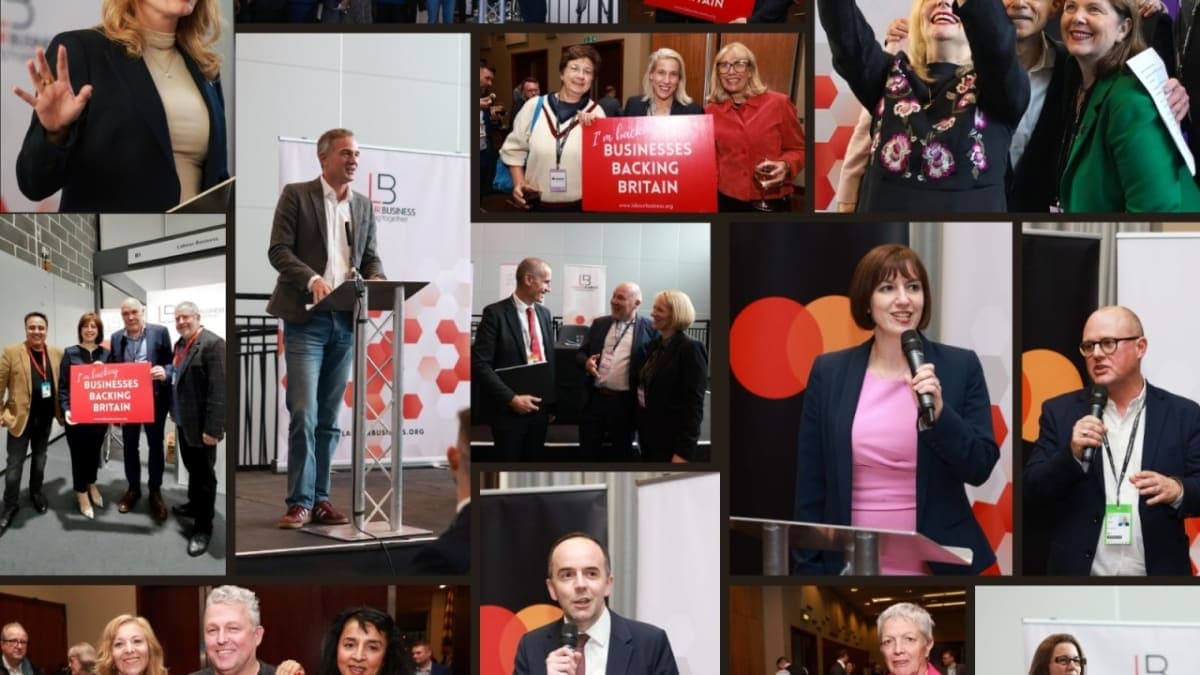
On Sunday afternoon, Labour Business hosted its showcase event — SME Sunday — where we held a series of roundtables on different business issues. Each was chaired by an MP or a subject matter expert. We ran a successful discussion on Employment Status.
Peter Kyle MP (Secretary of State for Business) and Blair Dougall MP (Small Business Minister) both addressed the hall. Afterwards, we spoke with Peter about the upcoming Employment Status Review and referred to the document soon to arrive in his inbox. We also reminisced about when, as a new MP, he had addressed one of our fringe events, explaining how engaging with the self-employed, freelancers, and others in Hove had been key to winning his seat.
Outside of events, we had numerous visitors to our stand in the conference exhibition — multiple ministers, MPs, representatives from regional mayors (and some of the mayors themselves), other groups, and many members. Our members are culturally diverse and run all sorts of businesses — from cleaning companies, engineering firms, and car mechanics to MOT centres, software contractors, and fitness instructors. It’s gratifying that our membership reflects the wider self-employment and small business marketplace. We also spoke with groups representing refugees who want to start their own businesses but face barriers to gaining the right to work. In addition, we discussed the idea of co-ops for the self-employed.
At the final Labour Business event, both Bridget Phillipson MP (Education Minister) and James Murray (Treasury) spoke. We were pleased that all our speakers at different events echoed the slogan that “Labour is pro-business and pro-worker.” But we suggested they go one step further now and say: “Labour is pro-business and pro-worker, whether employed or self-employed.” Look out for it.
About the Author
This is Small and Medium Enterprises News Official News Desk